|
![]() COMICS 101 By Scott Tipton 2013-06-19 - TAKING AIM: GREEN ARROW AND THE SOCIAL CONSCIENCE For Those Who Came In Late: Last week, in response to the popularity of the CW's hit show ARROW, we unearthed a lost entry from the COMICS 101 Archives exploring the early adventures of DC Comics' Green Arrow, a.k.a. Oliver Queen, a bland if likable enough chap who bore a striking conceptual resemblance to DC's most famous masked crimefighter, Batman. As the character regained more prominence in the mid-1960s through his membership in the popular JUSTICE LEAGUE OF AMERICA series, new JLA writer Denny O'Neil began altering Ollie's personality, or to be more precise, actually giving him one, portraying Ollie as a bit more hotheaded than the rest of the League, and often concerned with the smaller threats the League tended to pass over. Next up? A new look, to match the new attitude...
As for the story itself by Bob Haney, "The Senator's Been Shot!", it's fairly standard B&B territory, and not nearly as noteworthy as Green Arrow's new look.
There was a slight problem: the Black Canary was married, to longtime romantic interest private eye Larry Lance. However, since Larry was accompanying the Justice Society on an adventure here for the first time, well, ever, one might suspect that he's not long for this world, and sure enough ...
The Canary's husband sacrificed his life saving Dinah from Aquarius, and at adventure's end Dinah asks Superman if she can join the Justice League on Earth-1, as Earth-2 is "too full of memories." Superman kindly agrees, and refrains from pointing out that Earth-1, being more or less a duplicate of Earth-2, might not offer that much relief. Successive issues of JLA built up the relationship between Ollie and Dinah, with Dinah at times torn between her newfound love for Ollie and her loyalty to the memory of her husband. (It also wasn't much mentioned that Dinah, if her JSA membership was taken into account, must have been around 15 years older than Oliver. Guess she just looked really good for her age...)
With the loss of Queen's company and fortune went all of the superficial similarities to Batman: the Arrowcar, the Arrowcave, etc. Finally, Green Arrow was his own man.
Written by Denny O'Neil and drawn by Neal Adams, the famous "Hard-Traveling Heroes" series was O'Neil's attempt at bringing a sense of real-world relevance to the comic-book page, as Green Lantern Hal Jordan, Oliver Queen and one of Hal's alien bosses from the Guardians of the Universe explore the back roads of United States in a beat-up pickup truck, off to "look for America." To be honest, I'm a little on the fence about these stories. Historically, of course, they're very significant -- here was where the real baseline for Oliver's characterization as a hardline liberal was created, a persona that would for the most part remain Green Arrow's defining feature for the next three or four decades. This was also the basis for the Hal Jordan/Oliver Queen friendship that would become a staple of the DC universe for years to come. There are moments in these stories that have become powerful images from comics history, such as the scales falling from Hal Jordan's eyes in the first issue, or the revelation involving Ollie's ward Roy "Speedy" Harper. And of course, the gorgeous Neal Adams artwork is just beautiful, probably worth the price of admission all by itself. So what's the problem? Unfortunately, the storylines themselves don't hold up all that well.
Hal, as the puppet of authority continually being schooled by Green Arrow, is portrayed as either a mindless stooge of the Guardians, the government or any other establishment voice, or else a kneejerk rollover to liberal guilt, immediately shuffling to Green Arrow's side of the argument whenever Ollie barks his latest lecture. It probably would have been more interesting had Hal Jordan voiced a genuine opposing viewpoint to Ollie's, but that wasn't the story O'Neil was interested in telling. (Although readers did get a taste of that in the pages of JUSTICE LEAGUE OF AMERICA, but with another Leaguer at odds with Ollie. More on that later...)
Mostly, Hal and Ollie just come off as a couple of constantly bickering old biddies who are pretty unpleasant to be around.
When Hal is pelted with garbage from the tenement windows for stopping the assault, Ollie drops down from nowhere and explains why the crowd was against Hal: apparently the guy being assaulted was the local slumlord, who plans to evict the tenants to make way for a parking lot. Naturally, Ollie equates Hal's refusing to let the slumlord be murdered with Nazi war crimes, and points the finger of blame at Hal before being interrupted by one of the apartment building's tenants, who has a question for Mr. Lantern:
A chastised Hal Jordan has no answer, and he resolves to try to make the slumlord reconsider. Unsurprisingly, the ascot-wearing, cigar-chomping fatcat refuses, and when an enraged GL physically accosts the landlord, "The Man" steps in, in the shape of the giant blue head of one of the Guardians of the Universe, Hal's bosses. The Guardians send Hal away for some intergalactic busy work to cool off, while Ollie tries to entrap the slumlord with a phony blackmail scheme, but to no avail. Finally, Hal and Ollie work together to trick him into confessing his plot to murder Green Arrow in front of the Star City District Attorney, but the happenings do not escape the bigheaded gaze of the Guardians, furious that Hal disobeyed their orders. In response, Ollie does some more speechifying about the "hideous moral cancer" that's rotting the soul of America.
Not having been around at the time myself, I'm sure this was all coming from a sincere place in the mind of Mr. O'Neil, but it's a little hard to take from a modern perspective.
In the following issues, Green Lantern and Green Arrow face off against corrupt mining authorities (so evil, by the way, they actually have a bona fide Third Reich Nazi working as their security chief), the aforementioned white supremacist cult leader, and Native American lumber workers, before their journey is ended by the Guardians, who arrest their representative on a technicality, strip him of his immortality and sentence him to life in exile. Why exactly Hal Jordan continues to work for these bite-sized fascists is never quite explained...
Here Ollie is mugged by a group of drug addicts looking for money to score, and wounded with, of all things, one of his own arrows. Alarmed, Ollie calls in Hal for assistance, realizing that he hasn't spoken to his ward and crimefighting sidekick Roy "Speedy" Harper in over a month. Hal and Ollie's investigation leads them to a local drug dealer and an addict desperate for a fix, who gives Hal and Ollie a lead to Speedy's location. When the clueless Ollie finds Roy, he naturally assumes that his partner was working undercover to track down the narcotics racket. As it turns out, the normally liberal Ollie's sympathies apparently run out with the abusers of drugs:
Ollie and Hal head to their next lead, an abandoned airstrip, where the drug smugglers reportedly bring in the goods. The two are ambushed and knocked out, and left for the police, shot full of heroin. Luckily, Speedy arrives and manages to rouse Green Lantern who has to battle the ring-induced hallucinations brought on by the drugs, before he can use his ring to fly the three of them to safety. Back at Ollie's apartment, Roy explains to Hal and Ollie just why a young man might turn to drugs for solace:
Ollie's still completely oblivious, and only when he catches Roy in the act does he finally realize what's been going on:
Ollie, sensitive and caring liberal-minded soul that he is, reacts to Roy's addiction like any good parent would, with a backhand fist to the jaw.
After booting Roy out, Ollie reassures himself that he's "innocent of blame," and heads back out to try and beat up more "drug pushers." Hal is a bit more observant than Ollie (if not much) and suspects something's wrong with Speedy, finally tracking him down in Chinatown desperate for another fix. Luckily for Roy, Ollie's girlfriend Dinah is considerably more compassionate than Ollie himself, and it's she who helps Roy kick his heroin habit. Recovered, Roy slaps away Ollie's outstretched hand, and delivers his own sermon on the evils of drug abuse.
The family dynamics here are kind of mystifying. Roy blames Ollie for his drug abuse just because Ollie was gone for a few weeks on a trip. Geez, Roy, how needy are you? Isn't he at least 18 at this point? Take care of yourself, for pete's sake. Ollie's response isn't much better, as the ultimate bleeding-heart liberal beats up his own adopted son and boots him out, while every other form of social injustice has Oliver Queen doing an overboiled song and dance that makes alien super-geniuses shed a tear.
(Dinah has two kinds of luck in this series, by the way: bad and fricking awful.) As luck and plot necessity would have it, Dinah is in desperate need of a transfusion, and her exceedingly rare blood type is shared by -- you guessed it, Oliver Queen. Hal tracks down Ollie at the monastery and convinces him to come back, but not before the de rigueur faceoff with a thug who had Hal trapped in some conveniently yellow mud outside the monastery, forcing him to once more pick up his bow again and take arms against another. Hal gets Ollie to the hospital in time to save Dinah, and it looks as if everything is back to the status quo for Green Arrow. Once his hair grows back, anyway.
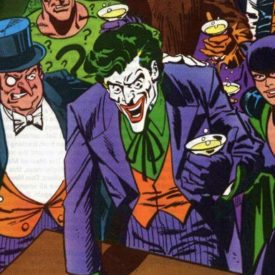
I always liked the fact that Haney wasn't afraid to ignore the reality that anyone with half a brain should be able to tell that Oliver Queen and Green Arrow are the same guy, such as this scene when Ollie ejects an inflatable dummy of himself from a hijacked airliner, to convince the Joker that Green Arrow is no longer on board.
As for his appearances in JUSTICE LEAGUE, writers there made use of his "angry liberal" persona to generate conflict within the group, most often with Hawkman, the Thanagarian police officer and the League's resident hardline conservative. It also gave them an opportunity to delve a little more into Ollie's character, such as in this moment from JLA #109, in which Hawkman has announced he's leaving the League, having been summoned back to his home planet, and Green Arrow no-shows the sendoff:
Green Arrow's discomfort with the League and feeling that the team tends to approach every problem with too much force (a sentiment brought to a head with the League's induction of Firestorm, a neophyte superhero who could manipulate matter itself) led to his quitting the team in issue #181, although he returned a mere 19 issues later to help free the League's founding members from mental control in JLA #200, "A League Divided," with his return seeming at the time to be a permanent one.
However, a mere 30 issues later, Green Arrow (along with most of the rest of the Justice League) would leave the team again following the "War of the Worlds" storyline, in which, after a near-disastrous battle with J'onn J'onzz's Martian brethren, Aquaman dissolved the team, with the proviso that only those members willing to commit to the team on a full-time basis could remain. But that's all a story for another column...
The series involved Ollie in a tale of corporate thievery and murder involving a heretofore unmentioned old friend of his, who bequeaths her fortune and company to him upon her mysterious death. The plotline here is involving if a little staid, but the art by Von Eeden is the real draw (particularly in issue #2, in which Green Arrow faces off against the illusion-casting Count Vertigo), combining Perez's flair for layout with a moody, Gene Colan-esque rendering style.
It's cool stuff, definitely worth picking up should you spot the back issues somewhere. However, the next real shift in Oliver Queen's evolution would come four years later, at the hands of writer-artist Mike Grell -- which is where we'll pick up next week. |
|